
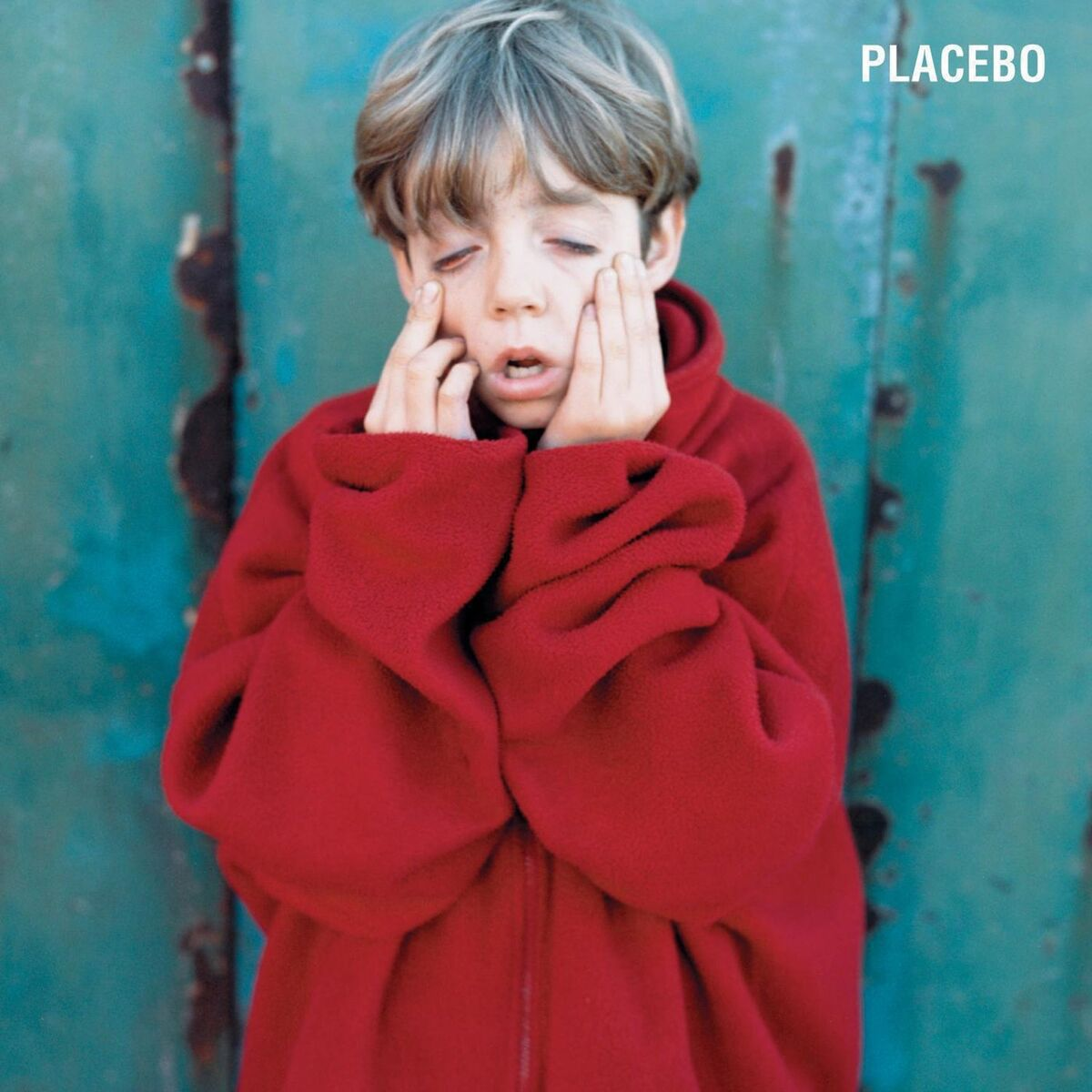
Placebo came onto the scene with their self-titled album in 1996, a time when Britpop had the UK up against a wall by its Adidas collar and although their lead singer and guitarist Brian Molko has British heritage, their sound didn’t echo the like of Oasis and Blur, regardless of this, the album peaked at number 5 in the UK and is arguably their best release. With it’s bleak, romantic and sexual themes, it overflows with poetic yearning. Their original line up of Brian Molko on vocals and guitar, Stefan Osdal on bass and Robert Schultzberg on drums with some added keys and synth towards the end of the album allows the sound to be simplistic, short, sweet and refreshing compared to a lot of newer albums that can feel over produced and chaotic.
‘Placebo’ is impossible to put a specific genre to, the tinny, hollow drums and rough guitar riffs in the first track ‘Come Home’ and later in ’36 Degrees’ are Rock influenced but ‘Come Home’ is a stream of Grunge, ‘washed up teenager’ imagery ‘Glass of petrol, vodka, gin, it feels like breathin’ it’s the kind of song you’d expect to be used in the ’90s TV series Skins.
‘Teenage Angst’ continues this; the title of this track could not be more fitting, especially for the kind of outcast, underdog fan base the band attracted. The sound is tighter and cleaner than ‘Come Home,’ but the fuzzy sound still feels very Grunge. The imagery is almost uncomfortable: ‘Since I was born, I started to decay.’ You can’t argue with it because it’s true, but the frank morbidity isn’t lost on anyone. ‘Bionic’ is the counterpart to this song; you can imagine ‘Teenage Angst’ was how a person feels, and now you’re hearing the pressure and the cause: ‘None of you can make the grade.’ Lyrically, the song is a repeat of two phrases, hammering how constant and unrelenting society can feel for young people. The music has a soft and continuous rise and fall underneath, again repetitive and even more exposed compared to both previous and subsequent tracks; its softer approach means it fits neater into Indie Pop.
The themes of self-deprecation are consistent but is even more apparent in ‘Hang on to Your IQ’, the entire song is a brave confession about one’s self. ‘Hang on to your IQ, to your ID’ is a message of being true to yourself and that anything that might not be ‘normal’ or ‘beautiful’ is all a part of your ‘ID’. Throughout Malko repeats ‘I’m lonely’ and admits ‘I’m a fool whose tool is small, it’s so minuscule it’s no tool at all.’ Even if these lyrics aren’t from his own experiences, I doubt you’d hear such words leave the mouth of Liam Gallagher. It’s an anti-rock song, staying in line with the band’s fluidity about gender and what being a man means.

Above – left to right – Brian Molko, Robert Schultzberg and Stephan Osdal 1996.
‘Nancy Boy’ is said to be a clap back to a quote from Suede’s Brett Anderson ‘I’m a bisexual man who’s never had a homosexual experience’. Molko has been opening bisexual his entire career and its easy to see why Anderson’s quote would ruffle his feathers, something tells me it wouldn’t have gone down well in the public eye in 2025 either. It’s a whirlwind of hedonistic smut ‘Looking out for number one // different partner every night’ it’s a heavier sound and more guitar driven than the rest of the album, reflecting some anger that the band may have felt while writing it, despite its rock, boarder line punk sound, it doesn’t feel out of place, in fact it comes as a welcome burst of vexation.
The most heart wrenching feature has to be ‘I Know’, its quoted by Molko to be about a derepressing time in his life made worse by the end of a relationship, to me though its always felt like the desperate acknowledgement from an artist to their muse that they know without their art, they wouldn’t matter ‘you want the song but not the singer’, and having no choice but to carry on ‘You got me wrapped around your finger.’ It’s a desperate sound featuring a consistent underlying drone of a didgeridoo throughout. The listener isn’t given a second to catch their breath before ‘Bruise Pristine’ begins, bringing back the heavy drums but this time featuring keys that sound like banging on metal school railings, transforming the song into a Cure-esk jangle.
The title of ‘Lady of The Flowers’ is that of a book by Jene Genet published in 1943, continuing the themes of gender fluidity; the book is about a drag queen called Divine. The line ‘He likes her attitude; he tries it on for size’, Could be a reference to the art of drag, however, the song could also be interpreted to be about someone who loves a girl who keeps hurting herself, can’t control her emotions, but ultimately is powerless to help herself; ‘confused and racked with self-doubt, she stole the keys to my house and then she locked herself out.’ It’s another desperately sad but beautiful song, it translates more like a piece of spoken word but the drum fills and drones keeps the atmosphere sombre and morose.
‘Swallow’ is both intense and confusing, it sounds like one side of a phone conversation which gives an uncomfortable air that you’re invading someone’s privacy, an outright intrusion. There’s barely one cohesive lyric throughout and the mention of the name ‘Marilyn’, ‘razor blads’ and ‘confiscate’ suggest themes of suicide but could also point to drug use and Marilyn Monroe’s cause of death was barbiturate poisoning. ‘I can’t remember where I put it’ could also mean someone has lost some drugs, the themes aren’t clear but the overall story and meaning is left open to interpretation. The bass is prevalent in the track, adding to the dingy atmosphere.
We are shown the door by ‘H.K Farewell’, a bright, airy, synth instrumental piece that feels like the sun rising after the dark throughout the album, helping you take a weight off after baring your soul, reminding you that it’s always darkest before the dawn.
I simply cannot fault this album, the way it reaches out to make the listener feel understood is unmatched, Placebo built a safe space for their audience from their very first release and continued to do so throughout their discography, the melancholy, oxymoron filled lyrics outline how life is both beautiful and hideous all at once, shining a light on the darkest points of life. The simple sound is so impactful alongside Molko’s nasal vocals it’s as a testament that good albums don’t have to be technically complicated.