
Queerbaiting Definition
The incorporation of apparently LGBTQ characters or relationships into a film, television show, etc. as a means of appealing to LGBTQ audiences while maintaining ambiguity about the characters’ sexuality. This includes kissing others of the same gender, posting false coming-out narratives, or falsely claiming to be in a same-sex relationship.
Going for Greatness
In 1999, business partners Ivan Shapovalov and Alexander Voitinskiy held auditions in Russia’s capital, Moscow; their mission? To find a new girl group to take over the music industry — but this wouldn’t be your S Club or Spice Girls. They wanted to create a narrative of two young girls deeply in love in the face of an unaccepting world, and when I say young, I mean young. Lena Katina, 15, and Yulia Volkova, 14, were the chosen two, and their lives were about to change forever.
Hitting The Ground Running
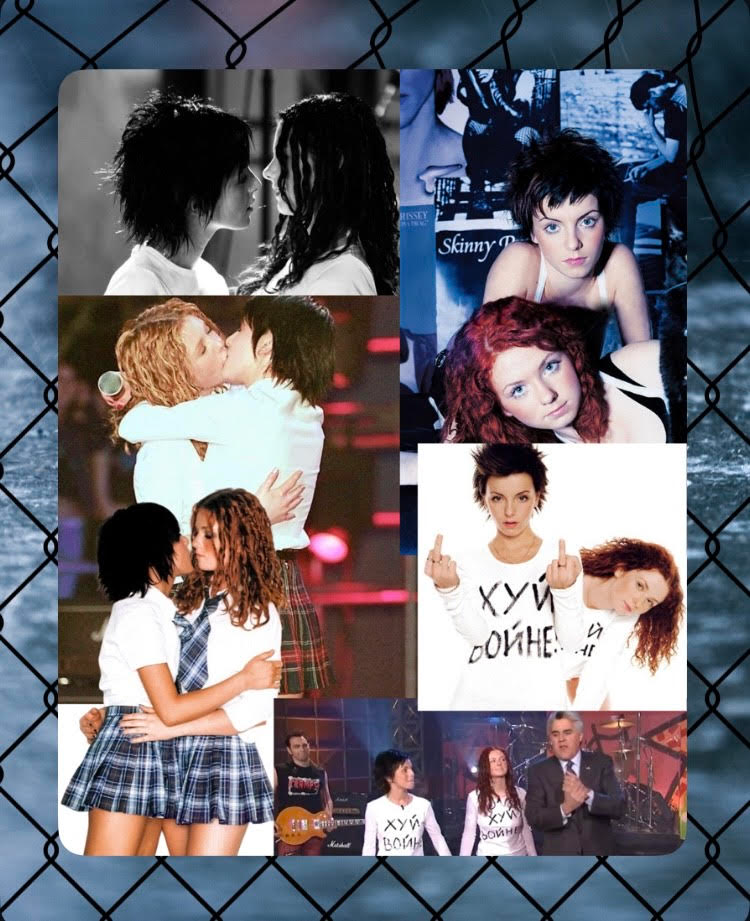
The team set about recording their breakthrough hit, written by Elena Kiper & Valery Polienko. They released “Ya Soshla S Uma” (“I’ve Lost My Mind”) alongside a music video, almost completely blowing their budget. The shocking footage of the two school-uniform-clad girls kissing in the rain behind a schoolyard fence, confessing their forbidden but undying love, shot to the top of the Russian charts – but this was just the beginning.
t.A.T.u vs The World
With Russia conquered, they set their sights on the English-speaking world, reworking the song into the version you’re most likely familiar with: All the Things She Said. Unsurprisingly, it took the world by storm, sparking controversy over their queer imagery (“think of the children!”) and the use of underage imagery in a sexualised setting. Regardless, it reached number one in Australia, Austria, Denmark, Germany, Italy, and the UK, despite being heavily restricted on ITV.
During their time in the US, they began filming their documentary Anatomy of t.A.T.u, following the behind-the-scenes of the cultural phenomenon. Here we see Shapovalov talking to a producer of The Tonight Show with Jay Leno ahead of the band’s appearance in February 2003. For some historical context, tensions between Iraq and the US were reaching boiling point, and it wouldn’t be long before the US Army would invade in order to overthrow Saddam Hussein. It was a topic on everyone’s lips – which is where Shapovalov wanted his band. Viewers see the formulation of a plan to have Katina and Volkova wear T-shirts sporting an anti-war slogan in Russian: “Fuck the War.”

The slogan was crudely scribbled onto long-sleeved white T-shirts as the girls sang on live late-night television, amplifying the stir by kissing at the end of their performance, despite being instructed not to by producers.
Although they gave the impression of caring about humanitarian causes and the people of Iraq, there is no public record or reliable news source indicating that t.A.T.u. (Lena Katina and Yulia Volkova) made any statement on the conflict. But it did get them on the radio.
t.A.T.u would also go on to place third in the Eurovision Song Contest for Russia that same year.
The Girls Behind the Music
The biggest secret Anatomy of t.A.T.u revealed was barely treated like a secret at all: they weren’t lesbians. Both had boyfriends at the time, and Volkova would discover she was pregnant with her daughter in 2004. The documentary also depicts Katina sitting in a hotel bathroom, cigarette in hand, on the phone to her priest in Russia doing a makeshift confession, as she felt her job led her to sin. Their real lives and on-stage personas were night and day.
Controversy
Many people in the LGBTQ+ community felt betrayed, as they’d found a safe space in t.A.T.u only to discover their real-life struggles in a homophobic society had been used for profit — gay for pay. However, others embraced the group for creating a positive, safe space for queer people and saw it as a form of representation. It was also a lot of people’s gay awakenings; there wasn’t a lot of exposure to queerness in media, and their music led many on a path of self-discovery.
Their costume choices were also heavily criticised for fetishising young girls in school uniforms. Unfortunately, this was a popular aesthetic at the time – Britney Spears and the 2007 remake of St Trinian’s spring to mind.
In 2004, Shapovalov parted ways with the duo, as he was deemed too focused on their image/ scandals over music revenue.

They released a statement in 2007:
“Many of our fans of alternative sexual orientation thought that we lied and betrayed them. This is not true! We’ve never done that and we’ve always advocated love without boundaries.”
With this, they continued on their artistic journey.
Less Music, More Controversy
Due to a feud in which Volkova struck out against Katina’s solo career – calling it “absolutely stupid” when she performed t.A.T.u songs alongside her solo material – the band split. Later, Volkova would dig herself an even bigger hole when she admitted she would “condemn” her son if he were gay.
“A real man must be a real man // God created man for procreation // a man has no right to be a fag.” She also made it clear that it was gay men she had a problem with, as she found lesbians “aesthetically much nicer.”
This understandably caused outrage among fans and non-fans. She later attempted to clean up her mess.
“I have many gay friends. I believe that being gay is still better than murderers, thieves or drug addicts. If you choose out of all this, being gay is a little better than the rest.”
But the damage was done. Katina publicly condemned the homophobic statements.
Katina’s attempted at a solo career never reached her former success, and Volkova largely stepped out of the spotlight. There have been whispers of a reunion after they performed together at the 2014 Winter Olympics in Sochi. Performing together as recently as this year.
Personal Connection
Like so many, I stumbled across All the Things She Said on YouTube as a young teen. Safe to say I was mortified – not just because it was sexual in nature, but because I was transfixed by it. The video sparked one of the most important journeys of my life. I’ve been opening bisexual for over a decade. Audibly, their music also genuinely appeals to me.

Watching the documentary, I’m not sure which irks me more: capitalising off the gay community, or capitalising off the war in Iraq. At least some good came out of their farse romance – it gave queer people some representation in media (albeit fake).
It’s also important to consider how much Katina and Volkova were really comfortable doing. Volkova openly expresses how she will do whatever it takes to reach stardom. Whereas Katina seems to struggle with the “fake it ‘til you make it” approach. They have frequently said their political messaging was largely orchestrated by management. Being head-hunted for such a project at 15 and 14 is uncomfortable enough.
Personally, I wouldn’t buy tickets to see them on principle, but I do listen to them regularly. The project was a product of its time and would never fly now – many artists today are accused of queerbaiting for much less, and its potentially career-ruining.
It gives a stark image of how the music industry works: you have to stand out to be noticed. Can we draw a line between an on-stage persona and real life? I’m left with these questions running through my head. How far is too far?