
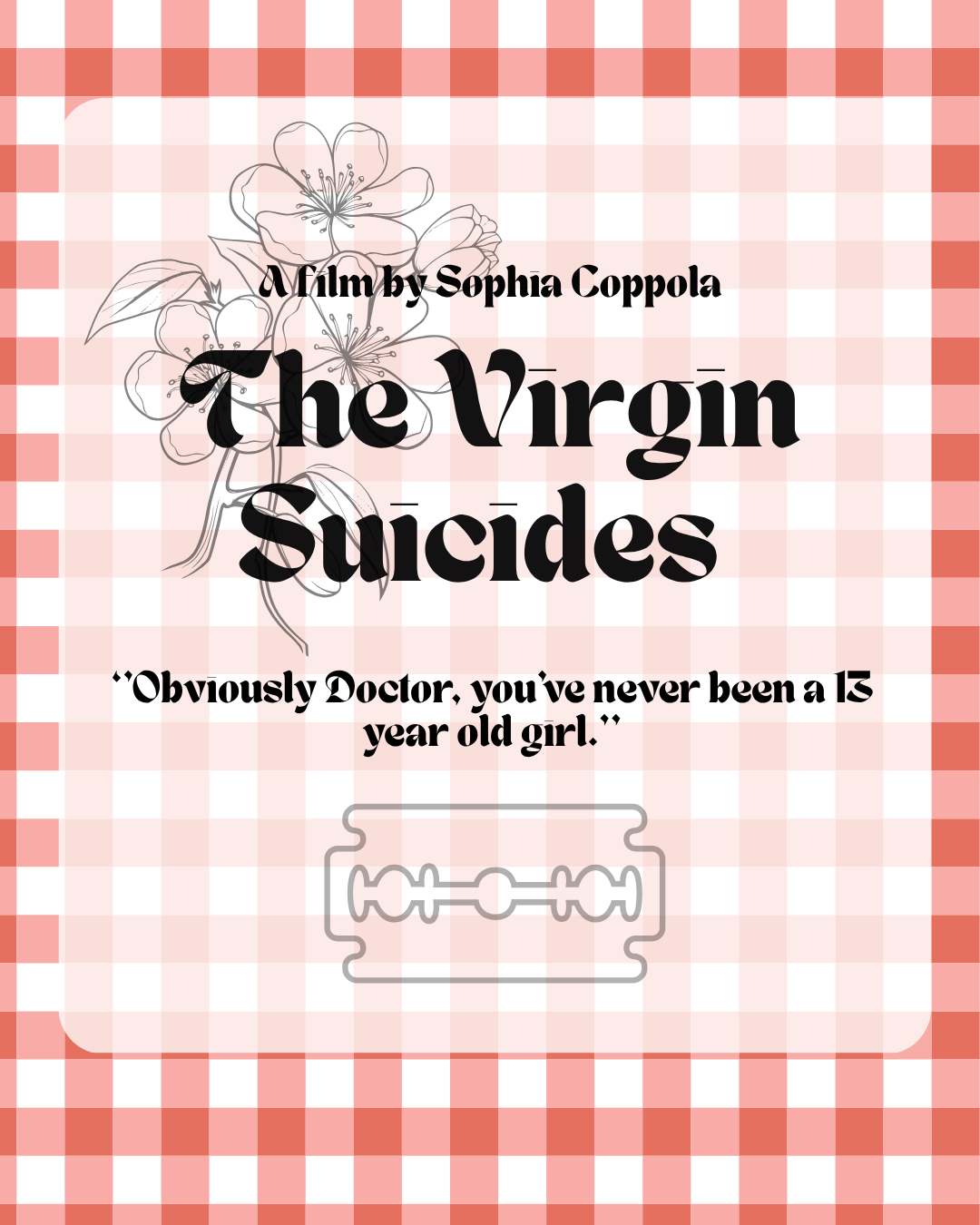
TRIGGER WARNING – This essay openly discusses suicide. If you’re experiencing suicidal thoughts, please know you’re not alone, call 116 123 for the UK’s suicide helpline, every lost life is a tragedy.
The Virgin Suicides is a cautionary tale, the book, written by Jeffery Eugenides in 1993 and later adapted into a film directed by Sofia Coppola in 2000. The film is very loyal to the book, exploring the intensity of adolescence, small town living and the way traumatic events, especially suicide and heartbreak, can affect those around it. The audience watch the five teenage Lisbon sisters, Therese, Mary, Bonnie, Lux and Cecilia, through the eyes of four teenage boys who become obsessed with them in the lead up to their group suicide. I rewatched it recently and was downloading the soundtrack before the credits began to roll. The use of music for communication is so powerful in a film that tackles such important taboo subjects.
The film also has its own score, written and performed by Electronic Dance group AiR but the song ‘Playground Lover’ is the only song that was featured in a noticeable way. Its vibraphone, instrumental ambience is used to several times throughout, at the start the highlight the contrast and stillness of Cecilia’s suicide attempt to the outside world, to the passage of time as we’re shown the gradual decay of the Lisbon house after the five sisters have all successfully taken their own lives.

Above – The Virgin Suicides score by AiR cover art.
The most morbid of song choices comes at the Lisbon’s party scene, ‘The Air That I Breath’ by The Hollies can be heard playing on the sound system as Cecilia excuses herself from the party to act out her second, successful suicide attempt, making the lyrics ‘all I need is the air that I breath’ stick out like a twisted joke.
Two different songs by the 70’s Rock group Heart are featured, the first being ‘Magic Man’, used to embody Trip Fontaine, the love interest, and later villain, of Lux Lisbon. It’s Funky, howling guitar licks and Ann Wilson’s raw vocals act as the perfect entrance theme for lady’s-man Trip as he struts down corridors, leaving a trail of swooning female classmates and teachers in his wake. The lyrics are also poignant, especially pertaining to Mrs Lisbon, the sister’s overprotective mother ‘’Come on home, girl’’ Mama cried on the phone’. Like ‘Playground Lover’ in the first scene, the song stops abruptly as Trip first sets eyes on Lux, emphasising that her beauty is a shock to his system as a middle-aged Trip describes her as ‘The still point of the turning world’ in his narration. The next song ‘How Can You Mend a Broken Heart?’ Sung by Al Green is heard faintly on Trip’s kitchen radio as his father, accompanied by his partner, gives him poor dating advice. Green’s silky tones over the Soulful, swaying melody mirror Trip’s moroseness, but is also a precursor for Lux’s broken heart later in the film.

Above – Heart – ‘Dreamboat Annie’. One of my favourite album covers.
Heart make their second appearance with their 1975 release ‘Crazy on You’, when Trip gets into his car after his awkward evening in front of the TV with the Lisbon family in a ploy to spend time with Lux, he thinks he’s blown it when Lux suddenly climbs onto his lap and they get hot and heavy in the driver’s seat. The thunderous guitar riff explodes into the scene to express the intense hormone-driven lust between two teenagers, especially Lux as it’s heavily implied that she, like her sisters, had never had such an encounter with the opposite sex.

Above – Trip Fontaine played by Josh Harnett.
The only song used in the sound track that wasn’t released either in the score or the ‘70s is again played on the radio, this time in the car as the sisters, joined by their dates, make their way to homecoming dance. ‘Everything You’ve Done Wrong’ was released by Sloan in 1996, regardless of this, with its rough around the edges production and Pop/Rock influences mean it’s right at home amongst the ‘70s tunes. It’s used for the purpose of narrative; the sisters being allowed to go the dance after Trip’s persuasion ‘don’t hide yourself away’ and our narrator’s, the younger boy’s, infatuation.
As the nervous eight enter the homecoming dance ‘Strange Magic’ by Electric Light Orchestra plays by the twinkling light of the disco ball. It sets a romantic tone, the use of another song centred around magic is a throwback to ‘Magic Man’ heard earlier, other young couples slow dance around them and the music makes the feelings of excitement and nervousness palpable. The song changes while Trip takes Lux under the bleachers, followed by her sister Bonnie and her date Joe Hill Conley, ‘I’m Not in Love’ by 10cc peaked at number 2 in the US charts in 1975, the year most of the film takes place, so it makes complete sense for it to play at homecoming. It’s cheesy but fits perfectly into the scene, not just because Bonnie isn’t too interested in her date, even after their first tentative kiss, but because of how Trip’s treatment of Lux later on.
Trip and Lux are serenaded by Styx’s ‘Come Sail Away’ as they are coronated homecoming King and Queen, its upbeat, playful melody sets the tone for the celebration, the shot of the girl’s father (a teacher and chaperone at the dance) watching her proudly from the dancefloor is heart-warming. But again, the song has a greater purpose, being about leaving ‘I think of childhood friends, and the dreams we had’ highlights their loss of innocence after to Cecelia’s suicide and little do the sisters know that they’ll be fighting to escape their home and lives soon enough. Re-watching the film, knowing what’s to come makes this scene all the more bittersweet.
After their short celebration, Trip leads Lux to the football field, where, while her sister waits in the car, eventually leaving her so as not to be late home, he takes her virginity. The instrumental of ‘Playground Lover’ is used again as Lux wakes up in the cold light of day, alone. She travels home and thus begins the punishment that leads to the sister’s suicide pact. The lack of lyrics gives the impression of loneliness and again draws attention to how young Lux is, a high school football field being almost adjacent to a playground. As part of Lux’s punishment for staying out all night, her mother makes her burn her Rock records, Lux is shown stalling for time on the stairs before begging her mother not to make her burn Kiss, or Aerosmith. This is the lightest of the punishments the girls receive but is the only one we any of them stressed over. This emphasises how important music is to a teenage girl; it’s often the songs of our adolescence that hold the most nostalgia for us later in life.

Above – Todd Rundegren.
The ultimate punishment comes in the form of imprisonment, the girls are prohibited from leaving the house, being pulled out of school by their mother. They have no real way of communicating to the outside world, much to the chagrin of the neighbourhood boys who watch them so longingly. They eventually come up with the idea of calling the girls on the phone and using records to communicate and they manage to have almost a full conversation. Starting with the boys playing ‘Hello, It’s Me’ by Todd Rungren, answered with ‘Alone Again, Naturally’ by Gilbert O’Sullivan. The boys then encourage the girls to try to come to them with ‘Run to Me’ by the Bee Gees but alas they’re ‘So Far Away’ sung by Carole King. It was this communication that captured my attention and led to writing this essay. It’s so simple, yet so effective and says so much without a single line of dialect.
After the girls carry out their pact and the audience are faced with the black screen of the credits, the lyrics of AiR’s ‘Playground Love’ are finally revealed, its gentle melody is cathartic after the harrowing events and it’s comforting in its familiarity from previous scenes.

Above – The Lisbon sisters – Lux, Cecilia, Mary, Bonnie and Therese.
The music choices in both the book, and in Sophia Coppola’s adaptation are perfect, they show a good understanding of the time, mimicking the kind of songs that would have been in a disk jockey’s rotation in the mid ‘70s and helping stir the audience’s emotions. The attention to detail when picking the songs goes to show how much care Coppola puts into her projects, this was later seen by audiences in her 2006 film Marie Antoinette which also stared Kristian Stewart. The Virgin Suicides is an exceptional example of how crucial the soundtrack is to complete a narrative successfully.