
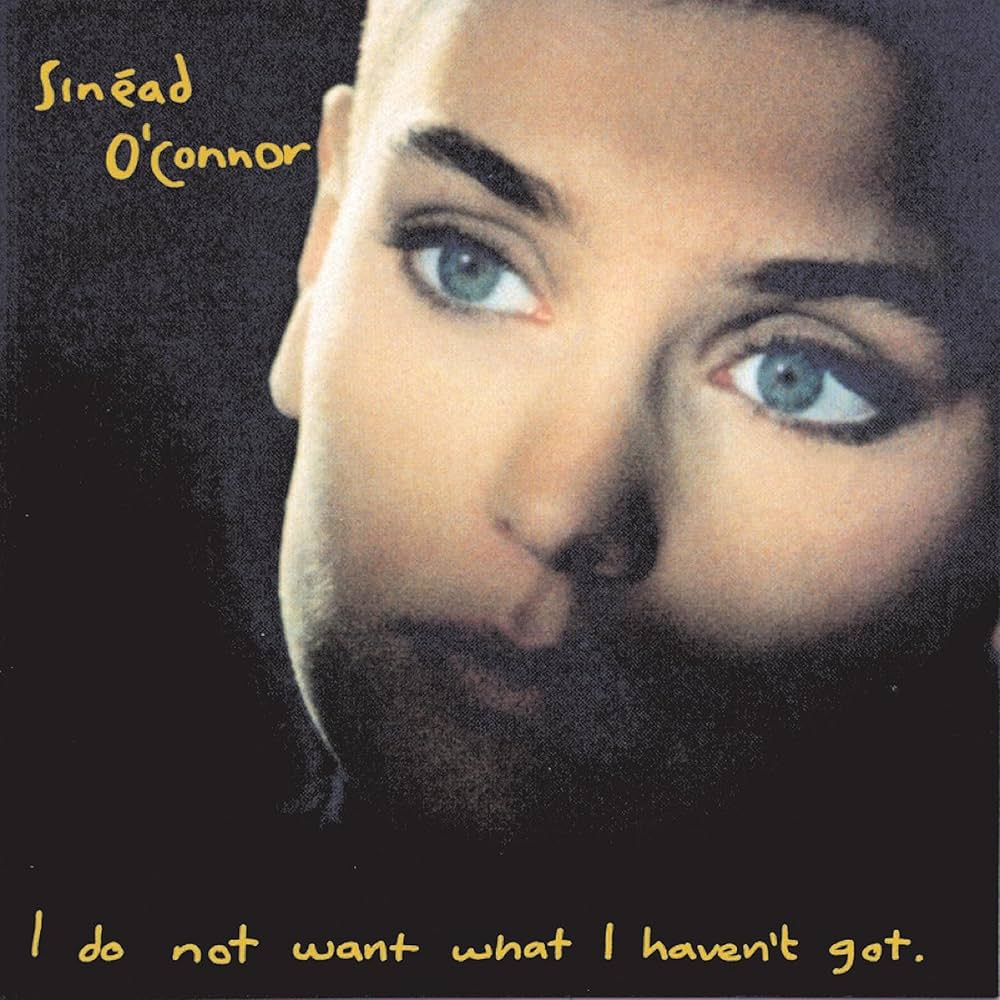
‘If we could talk about music, we wouldn’t need music.’ – Sinéad O’Connor.
This Saturday (26/06/25) marks the two-year anniversary of musician, producer, activist and one of my personal heroes, Sinéad O’Connor’s passing. In her honour, I’m revisiting her second album – ‘I Do Not Want What I Haven’t Got’, this release would propel her to mainstream success as a 24-year-old, newly single mother, featuring Prince’s ‘Nothing Compares 2 U’. Achieving the number one spot in the UK charts in 1990, the album is an insight into O’Connor’s quest of self-exploration as she navigates the complications of life.
The first track, ‘Feel So Different’ begins with the Serenity Prayer – ‘God grant me the serenity to accept the things I cannot change, courage to change the things I can and the wisdom to know the difference’. Never one to shy away from the subject of religion, O’Connor takes the prayer from her Catholic upbringing, asking for guidance in the journey of life she’s embarking on; it’s a gentle, yet powerful way to begin the album. Backed by a dramatic orchestra that ebbs and flows with the attitude of her voice, the song expresses how she’s changed, shedding old friends and awakening to the world around her.
We’re now put in touch with O’Connor’s birthplace of Ireland, ‘I am Stretched Over Your Grave’ is a translation of Gaelic “Táim sínte ar do thuama”, a 17th century poem detailing the deep devotion of a grieving man for the ‘girl that I loved as a child’. Her voice, which has an abstract, Enya quality, is completely exposed against a Hip-Hop drum beat until the last verse when a fiddle is introduced. It’s a powerful coupling of contemporary, traditional folk and sorrowful poetry, unexpectedly beautiful in its individualism.
In 1987, O’Connor gave birth to her first child, Jake, previous to this, she suffered three miscarriages, these tragedies are what inspired ‘Three Babies’. With only a soft acoustic guitar and orchestra, she bares her soul. ‘I have wrapped your cold bodies around me’ expresses how she would keep the memory of her lost children with her always, her raw emotion is almost piercing to the ear but the sweet melody creates a devastating lullaby. In 1990, O’Connor would fall pregnant again but chose to have an abortion, she recounts her experience and hostile feelings towards the child’s father, who opted to be absent from the unborn child’s life, through the song ‘My Special Child’, released later on the extended deluxe album. She would eventually go on to have a total of four children.
The bright, New Wave sound of ‘The Emperor’s New Clothes’ comes as a surprise following the previous tracks, it’s a big ‘fuck you’ to the criticism O’Connor faced from the very start of her career, this spanned from her young age ‘He thinks I just became famous // how could I possibly know what I want when I was only 21?’ to her signature shaved head and even as far as her Catholicism (she faced similar judgment when she later reverted to Islam in 2018) ‘Millions of people who offer advice and say who I should be’. It also hints at a breakdown in her relationship with her first husband, John Reynolds, who had collaborated with her on the drums on ‘The Lion and The Cobra’- ‘If I treated you mean, I really didn’t mean to // how pregnancy can change you’. This is solidified later in the album as ‘The Last Day of Our Acquaintance’ details the finalisation of a divorce, the breakdown of communication and ultimately, the relationship. O’Connor and Reynolds would later divorce in 1991.

Above – Protests in the streets of Hackney after the death of Colin Roach, 1983, led by his parents.
O’Connor being an outspoken activist, it’s a given that this album should feature a protest song. ‘Black Boys on Mopeds’ gets its name from the tragic death of Nicholas Bramble, a black man who was racially profiled by the Police, who suspected that the moped that was his property, was stolen. In the ensuing pursuit, Bramble lost control of the scooter and crashed, later dying of his injuries in hospital. O’Connor also dedicated the song to Colin Roach, a 21-year-old black man who was found dead from a gunshot wound to the head in the foyer of Stoke Newington Police station in 1983, an inquest ruled that his death was a suicide but many people in the community believed it to be a murder and the refusal of a public inquest suggested a potential coverup. This sparked outrage and protests concerning racial injustice in UK police conduct. She also calls Margret Thatcher out for appearing ‘Shocked by the deaths that took place in Beijing’ when she visited after the Tiananmen Square protest, where up to 10,000 people are believed to of been killed, because ‘the same orders are given out by her’, no doubt referring to the Falklands War which took place while she was Prime Minister of the UK. Again, supported only by an acoustic guitar, she paints a bleak but true picture of the institutionalised racism and hypocrisy the UK is built upon. It’s far from being all ‘Madam George and Roses’. Unfortunately, the world doesn’t look too different 35 years on.
I don’t feel there’s much need to be said about ‘Nothing Compares 2 U’ because it’s so well known and iconic, her signature vocals are front and centre, dripping in despair and complete loss at the end of a relationship, counting the seconds since her love left. O’Connor later discussed that the lyric ‘all the flowers that you planted Mama // all died when you went away’ reminded her so much of her mother, who had passed away in 1985, that the tears she sheds in the video are due to her own personal grief, the naked emotion can be heard in her voice and deepens the oppressive feeling of sorrow.
On the same subject of her mother, it’s common knowledge that O’Connor had a complicated relationship with the woman who raised her in a toxic and abusive household, ‘You Cause as Much Sorrow’ helps to express this. Childhood trauma often follows into adulthood and O’Connor finds herself grappling with her memories, even after her mother’s death ‘Why can’t you just leave me be? // It’s done nothing but destroy my life.’ As harsh as the lyrics seem, I can imagine how cathartic it would have been for her to write, like having a frustrated conversation with her mother from beyond the grave, safe to be completely honest and upfront.
O’Connor leaves us with the title-track, an a cappella that echoes as if recorded in a church, emphasised more still with ‘I have bread and I have wine, no longer will I be hungry, for the bread of life is mine’ referring to the Eucharist and declaring that her spirit is ready for whatever life has to throw at her. It’s hauntingly beautiful and encapsulates a woman who has been through so much, but is still strong and ready to take life by the horns and serves and an enviable display of strength.
This album is stunning in every way, dedicating itself to growth, rising above and giving a voice to those in need of volume. Sinéad O’Connor is a figure I look up to, not just for her music, but as a person who was always prepared to take risks for what she believed in, regardless of the cost, a recipe oozing with courage and talent and although ‘Nothing Compares 2 U’ was the commercial star, I think the other songs are so much more poignant and important. It’s so deeply personal that it feels like an intrusion into her inner sanctum and the audience is left feeling lucky they’ve had a chance to bear witness to it.
The world lost Shuhada’ Sadaqat, (the name O’Connor chose when she reverted to Islam) in 2023, she left so much incredible art and activism for the world to marvel at and I hope she found the peace she was always looking for.
RIP Shuhada’ Sadaqat.