
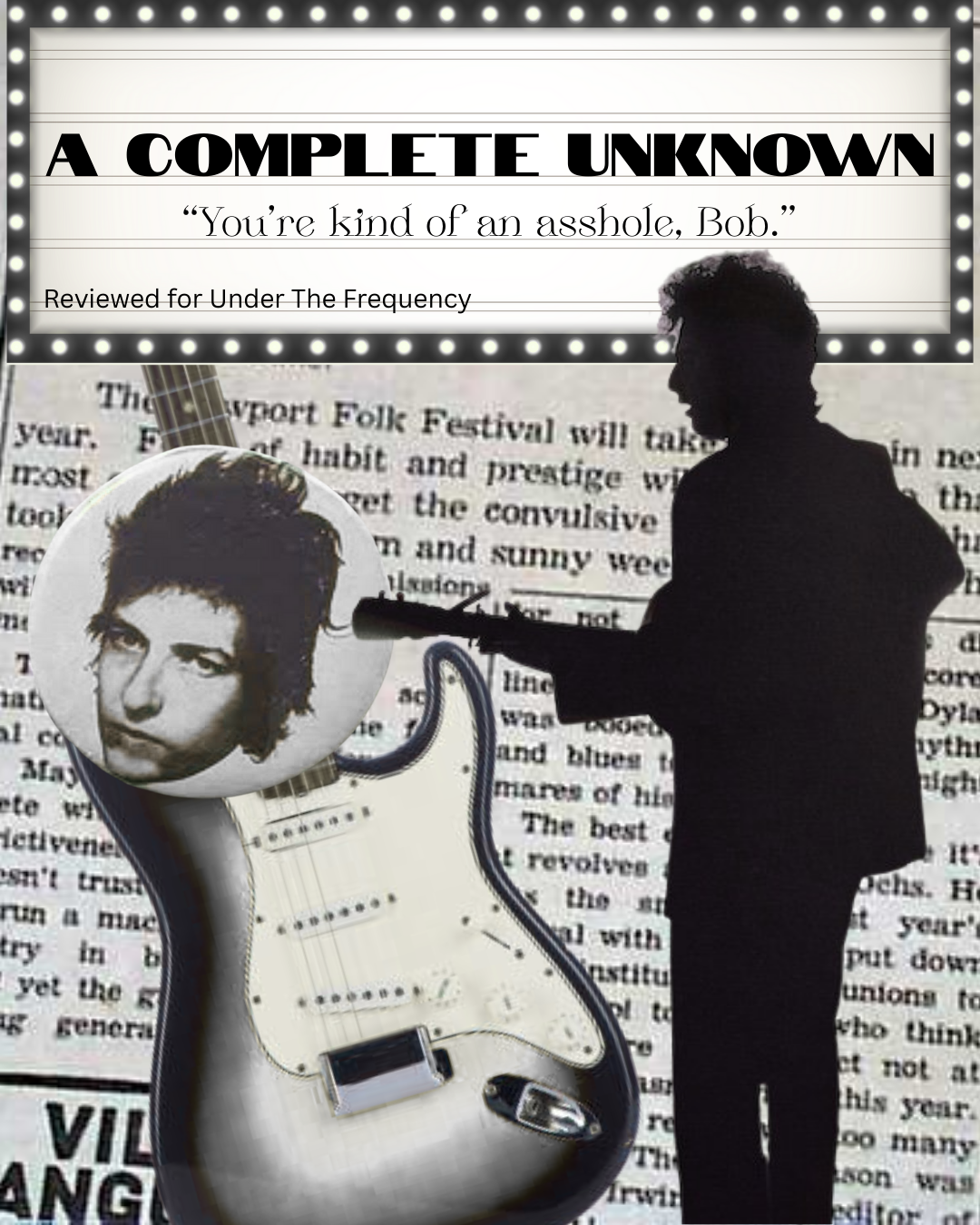
Bob Dylan – God, or Judas?
Bob Dylan is a notoriously private and cagey character, especially for someone who has garnered such success, a Nobel Prize winner of literature no less. In 2025, James Mangold took on the task of directing A Complete Unknown, giving audiences a backstage pass to the rise of Bob Dylan, played by Timothée Chalamet, we see Dylan the nobody, the cheater, liar and above all else, the musician.
The Plot
Set in New York City between 1960 and 1965—a time marked by political unrest, the civil rights movement, and the assassinations of Malcolm X and JFK—A Complete Unknown captures a cultural moment that sparked a folk music renaissance. Bob Dylan leaves his Minnesota hometown to immerse himself in the Greenwich Village scene, connecting with musical heroes Woody Guthrie (Scott McNairy) and Pete Seeger (Edward Norton). Seeger, recognizing Dylan’s potential, mentors him and helps launch his career. Dylan’s early relationship with Sylvie Russo (Elle Fanning)—a fictionalized version of Suze Rotolo—offers emotional grounding until the magnetic and already-famous Joan Baez (Monica Barbaro) enters the picture. The film follows Dylan’s rise, his struggles with fame, and culminates in his controversial electric performance at the 1965 Newport Folk Festival.
Performances
Chalamet channel’s Dylan’s slippery cool without tipping into a caricature, complete with a tight mouthed Minnesotan accent and self-assured swagger. Dylan is portrayed as cocky and often unlikeable, yet undeniably gifted. The supporting cast delivers sharp performances, with Elle Fanning capturing Suze Rotolo’s quiet warmth, making her heartbreak palpable—and her eventual departure from the toxic love triangle feel like a triumph. In contrast, Monica Barbaro’s Joan Baez is sharp and assertive. She sees through Dylan’s fabricated tales—like his mythic mentor “Carnival”—and confronts him without hesitation, famously kicking him out of her hotel room and barely enduring him on stage, bound only by audience expectations and record label obligations.

Memorable moments
While not all events are strictly factual, the storytelling is clear and focused—condensing five years into just over two hours is no small feat. Mangold’s deliberate pacing keeps the audience engaged, maintaining steady momentum from studio sessions to stage performances. Beyond the explosive Newport Folk Festival scene, complete with a brawl between Dylan’s manager and festival officials, the moment that gave me chills was a quieter one: the morning after Baez and Dylan spent the night together during the Chilean missile scare. As they harmonize on an early draft of Blowin’ in the Wind, their golden voices reveal a chemistry that goes far beyond the physical.
Sound
We mainly hear live performances throughout the film. Chalamet doesn’t just play Dylan, he sings him too, dedicating 5 years to learning to play the guitar and harmonica creating an authentic, convincing performance. The sound design is excellent, capturing everything from tape hiss in the recording studio to the piercing feedback during the near-sabotaged electric set. The ambient city sounds—buskers, live music spilling from clubs, even the distant tinkle of ice-cream trucks—bring the setting vividly to life. These lively moments contrast sharply with the silence between songs, underscoring the ever-present tension between Dylan the performer and Zimmerman the person. Often, we see Dylan murmuring new lyrics under his breath, feverishly jotting them down and experimenting with chords, as if he’s overflowing with music.
Music History in the Making
The 1965 Newport Folk Festival is a cultural explosion, marking the first time Dylan and his band play electric music to a bewildered and hostile crowd, dodging objects thrown in protest. This moment captures Dylan’s rebellious spirit—a musician caught between the freedom to follow his evolving creativity and the risk of alienating his old fan base. His struggle isn’t just with the audience and the likes of Seager, but also with himself.

Final Thoughts
Overall, I really enjoyed the film. I’m not usually a Chalamet fan, but his performance here is hard to fault. After seeing it, I found myself in a small record shop where someone claimed Chalamet sang Dylan’s songs better than Dylan himself—an opinion I don’t share, but it speaks to how convincing his portrayal is. The costumes felt authentic and lived-in, right down to Dylan’s overgrown, dirty fingernails. I don’t mind the typical ‘biopic tropes’ as long as the film isn’t rewriting history, and A Complete Unknown certainly stays true in a wider sense. Love him or hate him, Bob Dylan’s impact on music is undeniable.