
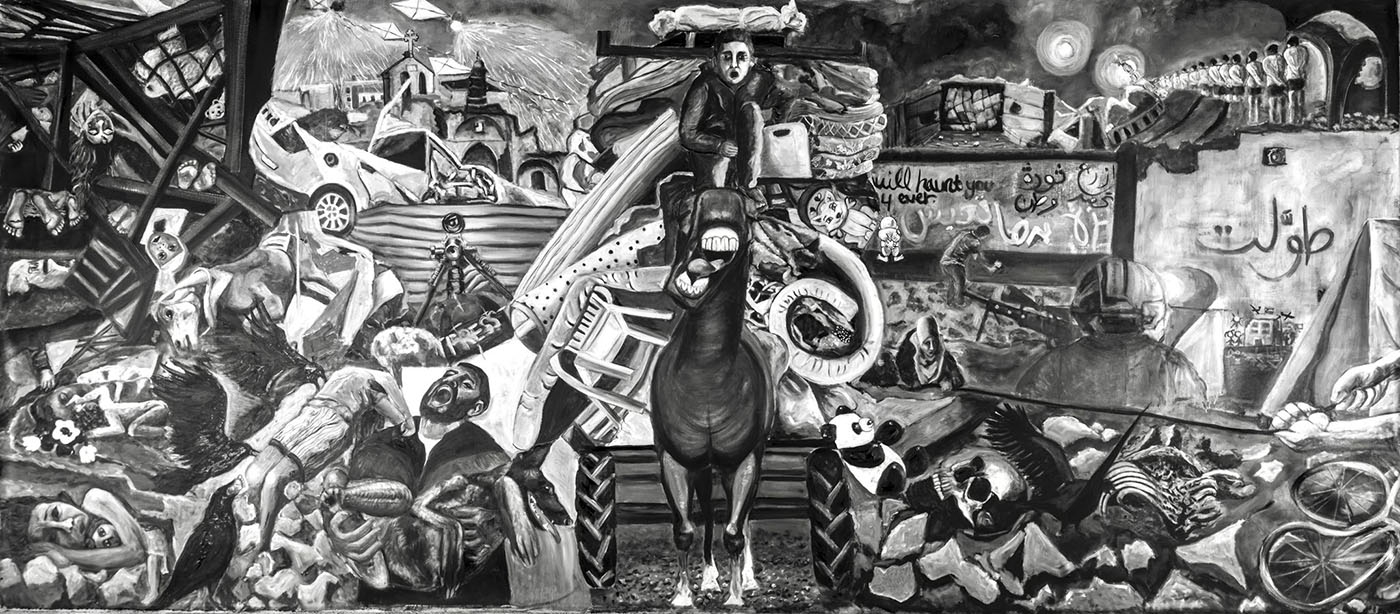
A 75 Year War
A violent power struggle between Israel and Palestine has unfolded since as far back as 17,000 BC, when the region was called The Holy Land. More recent events in modern history, such as the signing of the Balfour Declaration—in which Britain promised to create a Jewish National Homeland, renamed part of the territory as Israel, and relocated persecuted European Jews following the atrocities of World War II—marked the beginning of increasingly bloody conflicts in the region. The emigration of these persecuted peoples after the fall of the Nazis to their newly appointed homeland unfortunately caused an unfair division of land, displacing and disenfranchising an ever-growing community of Muslim Palestinians. These longstanding tensions have erupted into some of the deadliest uprisings in living memory.

October 7th 2023
In 1987, Palestinian-Islamic scholar Ahmed Yassin founded Hamas, a militant movement that aimed to oppose the state of Israel. Hamas controlled Gaza between 2007 and 2014, when the group reached an agreement with Fatah—a Palestinian nationalist and social democratic political party—to form a national government and take steps toward future peace. However, in 2018, the US government relocated its embassy in Palestine to Jerusalem. Palestinians viewed this move as a direct sign of US support for Jerusalem to become Israel’s capital, further escalating tensions.
These tensions finally reached a boiling point on October 7th, 2023, when Hamas launched an attack to break down the wall surrounding what they described as apartheid Israel, aiming to reclaim land and take hostages to begin what they called a true resistance. Many scholars and historians argue that Palestine has long served as a testing ground for the latest US weapons, often in collaboration with the notorious Israeli intelligence agency, Mossad. Some suggest that Mossad had foreknowledge of the incoming attack but allowed it to proceed to justify starting an outright war and gain more land and power in the region. Politically, Israel framed its actions as self-defence, pushing forward with the agenda of creating a “Greater Israel” at the expense of the Muslim population. Since October 7th, Israel has launched widespread attacks, caused mass displacement, blocked humanitarian aid from reaching civilians, and allegedly contaminated food aid with opiates, among other suspected crimes against humanity.
Hind’s Hall
That same year, Macklemore released Hind’s Hall, a song named after the hall at Columbia University that students renamed from Hamilton Hall to honor Hind Rajab—a six-year-old girl who died alongside her family when an Israeli tank targeted their car in January 2004. The students held a pro-Palestine protest at the university in April, but police eventually removed them. In the song, Macklemore makes points that resonate deeply with the long-running conflict:

- ‘The problem isn’t the protests, it’s what they’re protesting. – Throughout history, media outlets have painted protesters in a negative light—claiming violence where there is none—to delegitimize peaceful resistance and silence those fighting for justice. This propaganda often distracts from the atrocities of the ongoing genocide in Palestine and undermines freedom of speech and efforts to spread awareness.
- ‘A system that’s designed by white supremacy.’ – highlighting how racism continues to shape modern Western society. In this case, Islamophobia has surged since 9/11 and continues to influence public perception and policy.
- ‘Claimin’ its antisemitic to be anti-Zionist’ – The Jewish community has long been scapegoated and suffered deeply through history. Supporting Palestine does not deny or diminish the pain that Jewish people have endured; rather, it distinguishes between criticism of a political ideology and hatred of a people.
- ‘The Nakba never ended.’ – The Nakba refers to the mass displacement of 750,000 Palestinians beginning in 1947, when two-thirds of West Jerusalem was given to Israel, and the remaining territory was divided between Egypt and Jordan. Israeli forces attacked Palestinian villages, forcing residents to flee. Nakba translates to “The Catastrophe.”
- ‘The blood is on your hands Biden.’ – Speaking to President Biden directly, criticizing the US for continuing to back Israel despite clear evidence of war crimes and mass civilian casualties. As the world’s most powerful military force, the US leaves Palestine with little means to defend itself.
Support Across the Industry
Many in the music industry have spoken out in support of Palestine. On May 21st, Irish rapper Mo Chara (of the group Kneecap) was arrested for allegedly flying a Hamas flag during their set at the Wide Awake Festival. Since the UK government recognizes Hamas as a terrorist organization, expressing support for the group is considered illegal. Despite the controversy, Kneecap led “Free Palestine” chants during their performances to raise awareness and show solidarity.
“I don’t want to be 80, 90 years of age and my grandkids asking me why did nobody do anything about the Palestinian genocide? Me sitting there thinking, fuck, I didn’t do enough. I don’t want to be on that side of history.” – Mo Chara.

The band’s most recent tour posters were rejected from advertising in the London Underground. Transport for London stated that the posters were “likely to cause widespread or serious offence to reasonable members of the public.” Ironically, the posters featured only the band’s logo and tour dates. The band had previously advertised in the Underground without issue before Chara’s arrest.
On September 26th, 2025, the court dropped all charges against Mo Chara. Chief Magistrate Paul Goldspring ruled the charge as “unlawful” and “null.”
This year’s Glastonbury Festival also featured several artists who used their platform to support Palestine. Acts such as The Libertines, Jade Thirlwall (formerly of Little Mix), CMAT, Amyl & The Sniffers, and Wolf Alice all showed solidarity. Most notably, English rap duo Bob Vylan led a “Free Palestine” chant on stage before shouting: “Have you heard this one?” followed by a new chant: “Death, death to the IDF,” referring to the Israeli Defence Force. The BBC’s decision to broadcast the live performance led to the resignation of its Director of Music. The broadcaster has since announced it will no longer televise “high-risk” performances.
The End, For Now
As of September 2025, the United Nations has formally recognized Palestine as an independent sovereign state. While this development seems like a step forward, many believe it serves only to pacify protesters. Without mutual recognition and cooperation, a two-state solution—historically unstable—remains unlikely to bring lasting peace.
President Trump currently serves as mediator in a ceasefire, while leaders conduct peace talks. These discussions have resulted in the return of Israeli hostages under a 20-step plan. Whether this will lead to lasting harmony remains uncertain, but it will never bring back the countless men, women, and children who have already died. Many remain skeptical of the true agenda behind the negotiations.
Since October 7th, 2023, over 55,000 Palestinian civilians have lost their lives in the war. The UN reports that at least 100 children are killed or wounded in Palestine every day. Families have fled their homes, now forced to live in refugee camps with minimal aid, often starving and without proper medical care. In June of this year, Israel also launched attacks on Iran in what is now known as the “12-Day War” over nuclear weapon disputes, killing at least 950 people and injuring many more.
Outro
When I took this project on, I greatly underestimated how big it would become, the more I researched the deeper the rabbit hole became. I also couldn’t have felt the gravity of protest music as a 17-year-old student the way I do now ten years later, knowing the ways of the world. Music is a medium that has always brought people together in all emotions but most of all in the face of prejudice, encouraging unity and giving a voice to those who can’t speak for themselves. The music lives on to tell its story to the next generations in the hopes that with these reminders, history isn’t repeated. This being said, I can’t help but connect the songs I’ve spoken about from the past to current world events. I recently attended Brian Eno’s Together 4 Palestine at Wembley Arena. Being in a space with hundreds of people all standing against genocide, using music to express ourselves, give me a glimmer of hope that only music could bring.
Free Palestine.